The interacting boson model (IBM) is a model in nuclear physics in which nucleons (protons or neutrons) pair up, essentially acting as a single particle with boson properties, with integral spin of 0, 2 or 4.
It is sometimes known as the Interacting boson approximation (IBA).[1]:7
The IBM1/IBM-I model treats both types of nucleons the same and considers only pairs of nucleons coupled to total angular momentum 0 and 2, called respectively, s and d bosons.
The IBM2/IBM-II model treats protons and neutrons separately.
Both models are restricted to nuclei with even numbers of protons and neutrons.[1]:9
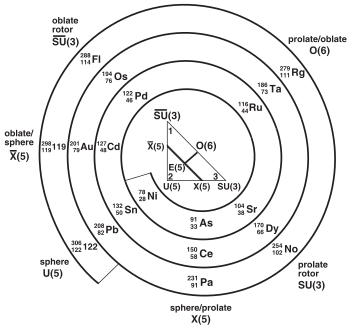
The model can be used to predict vibrational and rotational modes of non-spherical nuclei.[2]
History
This model was invented by Akito Arima and Francesco Iachello in 1974.[1]:6 while working at the Kernfysisch Versneller Instituut in Groningen, the Netherlands.
| This article uses material from the Wikipedia article Metasyntactic variable, which is released under the Creative Commons Attribution-ShareAlike 3.0 Unported License. |