This page discusses each of the main elements in the mixture of fission products produced by nuclear fission of the common nuclear fuels uranium and plutonium. The isotopes are listed by element, in order by atomic number.

Neutron capture by the nuclear fuel in nuclear reactors and atomic bombs also produces actinides and transuranium elements (not listed here). These are found mixed with fission products in spent nuclear fuel and nuclear fallout.
Neutron capture by materials of the nuclear reactor (shielding, cladding, etc.) or the environment (seawater, soil, etc.) produces activation products (not listed here). These are found in used nuclear reactors and nuclear fallout.
Germanium-72, 73, 74, 76
Arsenic-75
Selenium-77, 78, 79, 80, 82
Bromine-81
Krypton-83, 84, 85, 86
Rubidium-85, 87
Strontium-88, 89, 90
Yttrium-89
Zirconium-90 to 96
Niobium-95
Molybdenum-95, 97, 98, 99, 100
Technetium-99
Ruthenium-101 to 106
Rhodium-103, 105
Palladium-105 to 110
Silver-109
Cadmium-111 to 116
Indium-115
Tin-117 to 126
Antimony-121, 123, 124, 125
Tellurium-125 to 132
Iodine-127, 129, 131
Xenon-131 to 136
Caesium-133, 134, 135, 137
Barium-138, 139, 140
Lanthanides (lanthanum-139, cerium-140 to 144, neodymium-142 to 146, 148, 150, promethium-147, and samarium-149, 151, 152, 154)
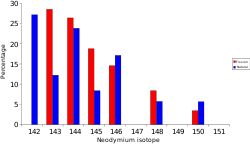
A great deal of the lighter lanthanides (lanthanum, cerium, neodymium, and samarium) are formed as fission products. In Africa, at Oklo where the natural nuclear fission reactor operated over a billion years ago, the isotopic mixture of neodymium is not the same as 'normal' neodymium, it has an isotope pattern very similar to the neodymium formed by fission.
In the aftermath of criticality accidents, the level of 140La is often used to determine the fission yield (in terms of the number of nuclei which underwent fission).
Samarium-149 is the second most important neutron poison in nuclear reactor physics. Samarium-151, produced at lower yields, is the third most abundant medium-lived fission product but emits only weak beta radiation. Both have high neutron absorption cross sections, so that much of them produced in a reactor are later destroyed there by neutron absorption.
| This article uses material from the Wikipedia article Metasyntactic variable, which is released under the Creative Commons Attribution-ShareAlike 3.0 Unported License. |